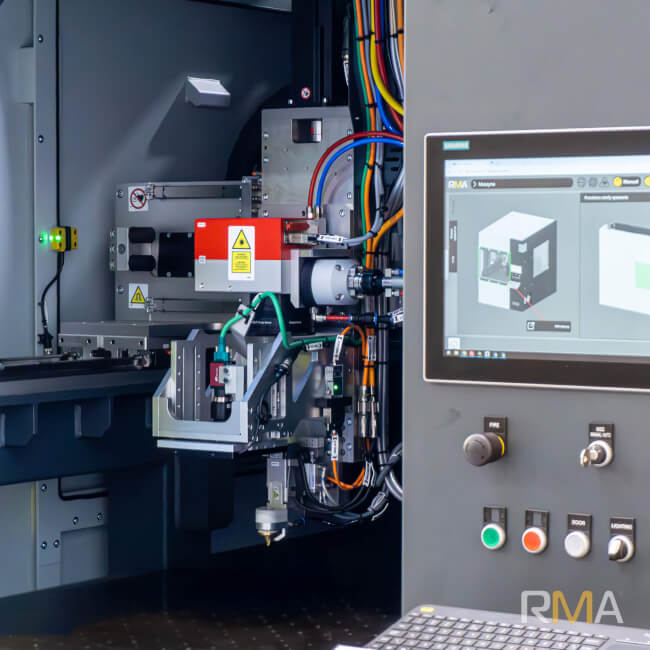



Aluminium has long been one of the key structural materials in industry – from automotive, through energy, to advanced enclosure systems and precision components. Its low weight and good mechanical properties make it the natural choice wherever the strength-to-weight ratio matters.
From the perspective of material joining technologies, aluminium remains a demanding material. In particular, laser welding of aluminium places high demands on process stability and parameter control. In industrial practice, the key question is not whether a weld can be made, but whether the process can be maintained in a repeatable and predictable manner under production conditions.
The specific characteristics of aluminium in laser welding stem directly from its physicochemical properties. From an engineering standpoint, three factors are most significant.
The first is high thermal conductivity, which causes rapid dissipation of energy from the beam interaction zone. As a result, maintaining a stable weld pool requires precise delivery of energy in a sufficiently concentrated form.
The second factor is the natural aluminium oxide layer (Al₂O₃). Its melting point significantly exceeds that of the base material, which disrupts wetting and can lead to process instability.
The third aspect is susceptibility to metallurgical defects, particularly gas porosity and hot cracking. Their occurrence is closely linked to process parameters and material preparation.
Unlike many conventional welding methods, the laser process is characterised by a narrow range of stable parameters. Small deviations can lead to significant quality changes.
In practice, the following are commonly observed:
For this reason, the key issue is not a single parameter, but defining and maintaining a process window in which the process remains stable.
The primary variables influencing the process are:
The relationship between power and speed can be described by the linear energy of the process:
E = P / v
In practice, this means that both too low and too high linear energy can lead to defects – lack of penetration or excessive weld pool instability, respectively.
One of the most frequently underestimated factors is material preparation before the process. Even optimally selected parameters will not ensure stability if the surface does not meet quality requirements.
Of critical importance are:
In production conditions, this means that standardisation of the part preparation process is essential.
Laser welding of aluminium will not be the optimal solution in every application. Problems arise particularly when:
In such cases, the risk of process instability and lack of repeatability increases significantly.
From an industrial implementation perspective, process verification before production implementation is a critical step.
This includes:
This approach enables the transition from the experimental stage to a controlled production process.
Compared to methods such as TIG or MIG, laser welding of aluminium offers a number of significant advantages:
At the same time, this technology is more demanding in terms of parameter control and input material quality. In practice, its implementation should be preceded by a process feasibility analysis.
| Material Thickness [mm] | Laser Power [kW] | Welding Speed [m/min] | Process Mode | Typical Application |
|---|---|---|---|---|
| 0.5 – 1.0 | 0.5 – 1.5 | 3 – 10 | conduction / shallow keyhole | thin-walled enclosures, electronics |
| 1.0 – 2.0 | 1.0 – 2.5 | 2 – 6 | transitional / keyhole | precision components, automotive |
| 2.0 – 4.0 | 2.0 – 4.0 | 1 – 3 | stable keyhole | load-bearing structures, profiles |
| 4.0 – 6.0 | 3.0 – 6.0 | 0.5 – 2 | deep keyhole | structural elements |
| 6.0 – 8.0 | 5.0 – 8.0 | 0.3 – 1 | deep keyhole / multi-pass | heavier components |
In practice, an increasing number of companies choose to conduct tests in specialised laboratories that allow real conditions to be replicated and technology feasibility to be assessed.
RMA's welding laboratory in Gdynia offers the possibility of:
Laser welding of aluminium is a technology with great potential in industrial production, but its effective application requires an engineering approach based on data and testing.
Of key importance are:
Only when these conditions are met is it possible to achieve the stability and repeatability that are essential in series production.
| Defect | Symptoms | Main Causes | Corrective Actions |
|---|---|---|---|
| Gas Porosity | Pores in the weld cross-section, reduced fatigue strength | contaminants (oils, moisture), unstable weld pool, excessive linear energy | thorough surface cleaning, parameter optimisation (P/v), improved shielding gas coverage |
| Lack of Penetration (LOP) | Discontinuity through material thickness | insufficient power, excessive speed, defocused beam | increase power, reduce speed, correct focal position |
| Excessive Penetration / Burn-Through | Material perforation, edge deformation | excessive linear energy, insufficient speed | reduce power, increase speed, correct focusing |
| Hot Cracking | Micro-cracks along the weld axis | unfavourable alloy composition, high shrinkage stresses, improper thermal balance | select appropriate filler material, optimise parameters, change joint geometry |
| Keyhole Instability | Variable penetration depth, spatter | excessive or unstable power, incorrect focusing, material reflectivity | stabilise parameters, optimise focal point, select appropriate laser source |
| Weld Oxidation | Dull, grey surface, degraded properties | insufficient shielding gas, gas turbulence | increase gas flow, change nozzle / feed direction, optimise gas (e.g. Ar, He) |
| Excessive Spatter | Irregular weld face, surrounding contamination | unstable weld pool, excessive energy, contaminants | reduce linear energy, improve cleanliness, stabilise process |
| Component Distortion | Geometry change after welding | excessive heat input, lack of fixturing control | reduce linear energy, use clamping fixtures, optimise welding path |