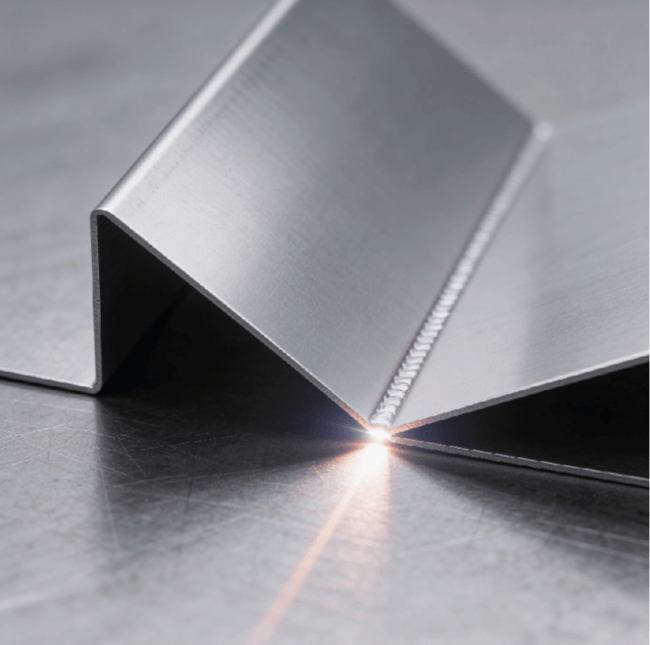


Laser welding heat exchangers is becoming the standard in modern industrial production. Companies looking to increase product performance, reduce costs, and ensure consistent weld quality are rapidly replacing traditional welding methods with laser-based solutions.
What makes laser welding heat exchangers so effective? High processing speed, extreme precision, repeatable weld quality, ease of automation, and lower operational costs. As laser sources become more affordable, more manufacturers are adopting this technology as a competitive advantage.
Laser beam welding is no longer limited to the automotive industry. Today it plays a critical role in battery production, medical devices, energy systems, and especially in advanced heat exchanger manufacturing, where compact design and leak-tight welds are essential.
Heat exchangers require:
Laser welding heat exchangers meets all these requirements. The concentrated energy input allows precise control of the weld pool while minimizing heat-affected zones. This is crucial for stainless steel, aluminum, and other alloys commonly used in exchanger construction.
Manufacturers that specialize in custom heat exchanger projects, such as RMA, use laser welding to produce highly compact, efficient, and cost-optimized solutions. You can see examples of these advanced implementations here:
👉 Customised heat exchanger projects by RMA
One of the biggest advantages of laser welding heat exchangers is production scalability. Depending on the exchanger design, lasers can be used for 50% to even 95% of all welded joints.
This results in:
In high-volume production, manufacturers create thousands of kilometers of laser welds per year. At this scale, maintaining weld quality is not optional — it is critical.
A major trend in laser welding heat exchangers is real-time weld quality monitoring. Modern manufacturers rely on inline systems that detect defects during the welding process — not after production.
One example is the Laser Welding Monitor (LWM), which analyzes:
Each weld produces a unique signal pattern. Deviations from the reference pattern immediately indicate issues such as:
This allows manufacturers to stop defects at the source, preventing costly scrap and ensuring every heat exchanger meets strict performance requirements.
Modern industries demand smaller, lighter, and more efficient heat exchangers. Traditional welding methods often introduce excessive heat, leading to distortion and design limitations.
Laser welding heat exchangers enables:
These capabilities open the door to innovative exchanger architectures that were previously impossible to manufacture.
Ongoing technology development in this field can be explored here:
👉 Laser technology development at RMA
Smart factories rely on data. In laser welding heat exchangers, monitoring systems continuously collect process data that can be integrated with:
Every weld can be digitally recorded and linked to a specific product, operator, batch of material, and machine parameters. This level of traceability is essential in industries like energy, marine, defense, and medical technology.
It is a high-precision welding method that uses a focused laser beam to create strong, leak-tight joints in heat exchanger components with minimal thermal distortion.
Laser welding offers deeper penetration, less heat input, faster processing, better repeatability, and easier automation — all critical for high-performance heat exchangers.
Yes. One of the main advantages of laser welding heat exchangers is the ability to join very thin materials without warping or burn-through.
Modern systems use inline monitoring sensors that analyze light emissions and thermal signals to detect defects in real time.
Absolutely. Laser technology is ideal for both prototyping and serial production of custom-designed exchangers, such as those developed by RMA.
The shift toward laser welding heat exchangers is driven by performance, efficiency, and digital quality control. Companies that invest in this technology gain:
As laser systems continue to evolve, their role in heat exchanger manufacturing will only grow — setting new standards for precision engineering and intelligent production.